1. Introduction
School sports field lighting tenders are won or lost on the technical specification chapter, not on price alone. Municipal education EPC teams and school facility managers need parameters that prove: the system meets national or EN 12193 standards, will last 8–10 years, and stays energy-efficient over its lifecycle. This guide lists the exact specifications you should write into the tender document, the values evaluators expect, and the common "generic" language that causes technical disqualification.
2. The Standard That Governs School Sports Lighting
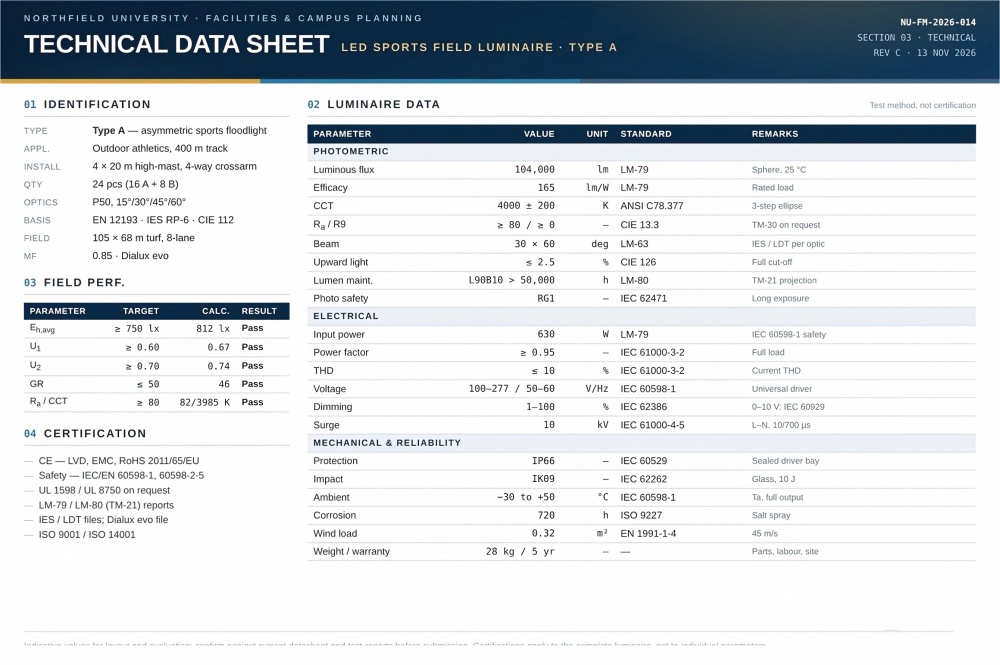
Most international school projects reference EN 12193 (European standard for sports lighting). It divides venues into three classes:
| Class |
Venue Type |
Horizontal Illuminance |
Uniformity U1 |
Glare Limit (GR, CIE 112) |
Color Rendering |
| Class III |
School training, community recreation |
75 – 200 lux |
≥ 0.4 |
GR ≤ 55 |
Ra ≥ 60 |
| Class II |
Club competition, inter-school matches |
200 – 500 lux |
≥ 0.5 |
GR ≤ 50 |
Ra ≥ 70 |
| Class I |
Regional / televised events |
500 – 750 lux |
≥ 0.6 |
GR ≤ 45 |
Ra ≥ 80 |
A standard primary or secondary school sports field tender should target EN 12193 Class III (minimum) to Class II (preferred). Note that outdoor sports lighting glare is measured by GR (Glare Rating per CIE 112), not by indoor UGR — writing UGR in a sports tender is a common technical mistake. Writing "professional level" without naming the class is also a frequent scoring error.
3. Must-Have Technical Parameters in the Tender
| Parameter |
Recommended Tender Value |
Why It Matters |
| Luminous efficacy |
≥ 150 lm/W |
Directly drives energy savings claim |
| Lamp life (L70) |
≥ 50,000 hours |
Proves 8–10 year service life |
| Ingress protection |
IP66 minimum |
Outdoor school courts must survive rain and cleaning |
| Corrosion resistance |
C4 salt spray / 96 hours |
Required for coastal schools |
| Color temperature |
4000K – 5000K |
Neutral white; not blue-white (6000K+) |
| Color rendering (Ra) |
≥ 70 |
Required for Class II and above |
| Glare control |
GR ≤ 50 (Class II) / GR ≤ 55 (Class III), per CIE 112 |
Outdoor sports glare metric; UGR is indoor-only |
| Surge protection |
≥ 10kV |
School poles often hit by lightning |
| Operating temperature |
-30°C to +50°C |
Covers most school locations |
| Warranty |
5 years minimum |
Standard for municipal education tenders |
4. Pole and Foundation Specifications
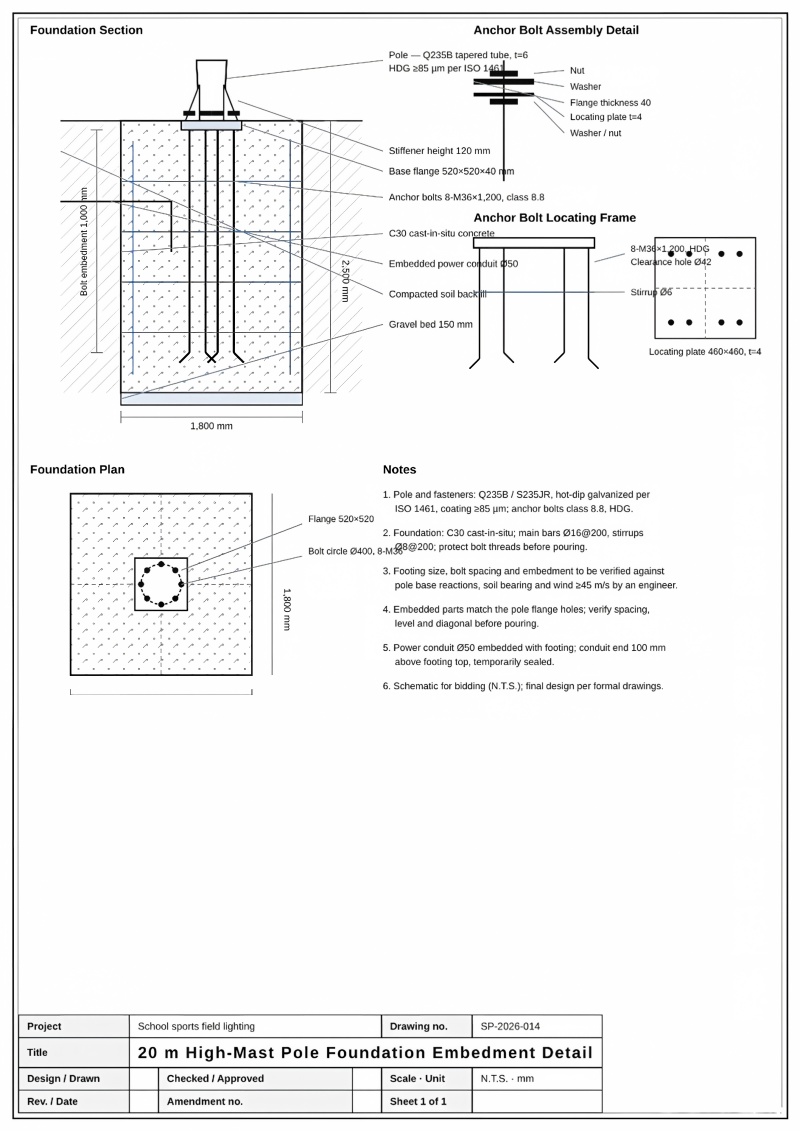
Lamp poles for school sports fields must be hot-dip galvanized, minimum wall thickness 4mm for 12m poles, with a welded base flange of 20mm. Wind speed design should match local code — in coastal typhoon zones this means 10–12 on the Beaufort scale. Always require supplier to provide wind load calculation report; generic "standard pole" language will lose technical points.
5. Certifications That Win School Tenders
CE and RoHS are table stakes for most countries. For school tenders, add: ENEC (European safety), LM-79 / LM-80 / TM-21 (US performance data), IK10 impact resistance (ball-proof), and DLC premium for US federal-funded school projects. Suppliers without these test reports cannot respond to serious municipal tenders.
6. Common Tender Writing Mistakes
Writing "high brightness LED" without lumen value. Specifying 6000K+ "cool white" — causes complaints and fails visual comfort. No GR value in the document (and do not write UGR — that is indoor-only). Requiring 3-year warranty in a municipal project where 5 years is standard. Forgetting surge protection; school poles are lightning targets. No required light distribution simulation (Dialux) submitted as bid document.
7. FAQ
Q1: What class should a primary school sports field target?
A1: EN 12193 Class III is the minimum; if the school hosts inter-school matches, upgrade to Class II. Never specify Class I for a normal school — it over-lights and wastes budget.
Q2: Is 50,000 hours L70 realistic?
A2: Yes for quality LED fixtures with proper thermal design. If a supplier quotes 100,000 hours without LM-80/TM-21 report, treat it as marketing language. Ask for the test report; real municipal evaluators will.
Q3: Do we need anti-glare louvers in the tender?
A3: Yes. Write "asymmetric optical lens with GR ≤ 50" instead of "anti-glare design". The latter is meaningless; the former is measurable per CIE 112. Do not write UGR — that is an indoor office metric, not a sports lighting one.
8. Get Tender-Ready Technical Documentation
We supply complete tender response packages for school sports field lighting: EN 12193 compliance statement, LM-79/LM-80/TM-21 reports, IK10 and IP66 certificates, wind load calculation, and Dialux simulation for your specific field. Contact us with your tender document and we will map our product line to your technical requirements.
Related Products
Related Cases
Your Reliable Outdoor Lighting Partner
HRLUXSOLAR focuses on mid-to-high-end outdoor lighting with strict quality standards and a rigorous, responsible team. We take quality as the core and professionalism as the foundation to provide stable and durable outdoor lighting products.We specialize in professional services for municipal and commercial engineering projects, delivering customized lighting solutions for smooth project implementation. We support flexible customization, efficient delivery and full-process technical support to meet diverse project demands.Committed to being your trusted outdoor lighting partner, HRLUXSOLAR keeps improving to create better lighting value for your projects.
Need a Dialux simulation for your project? Click here for a free lighting plan.